
Key Takeaways
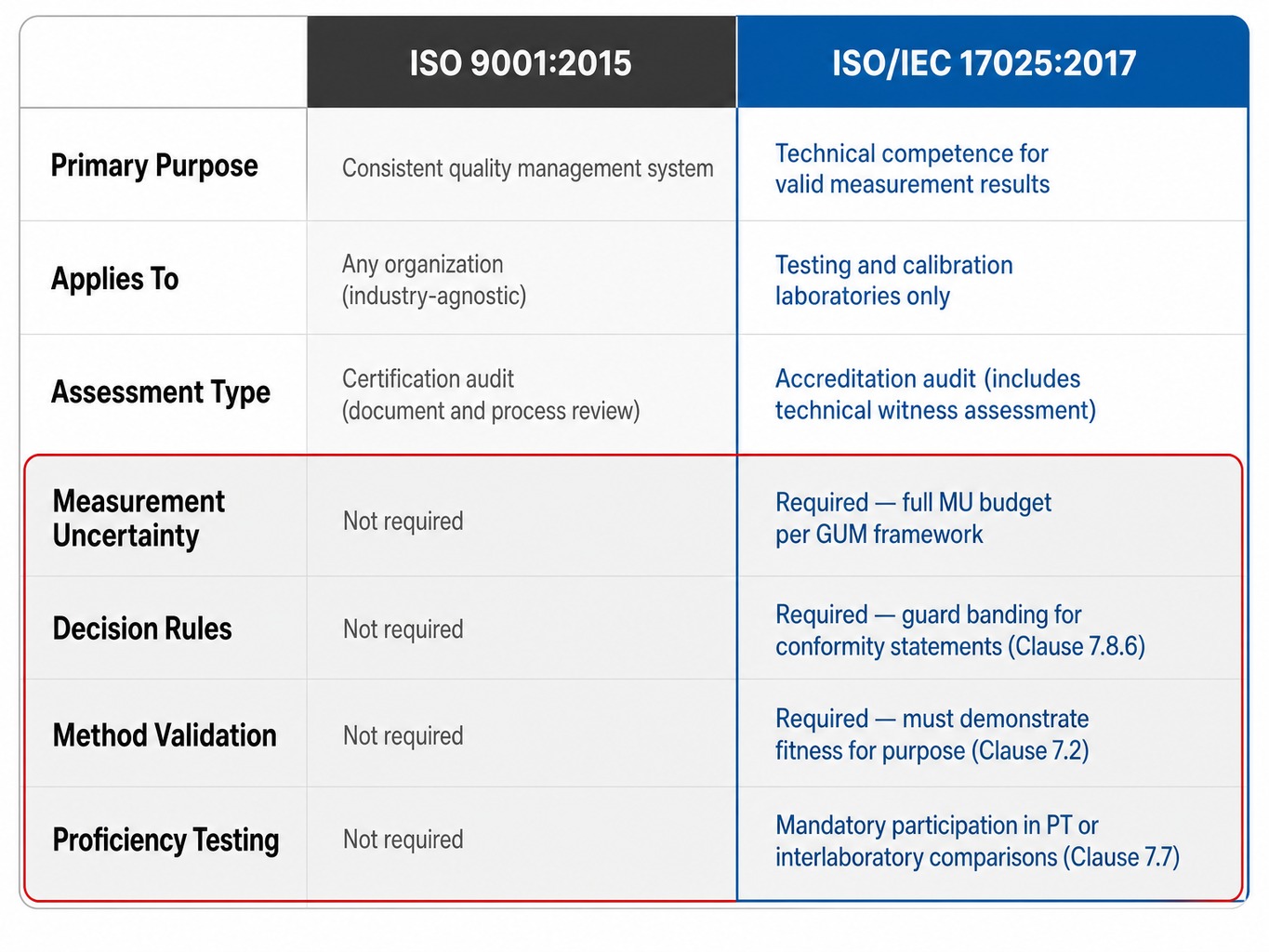
- ISO 9001 certifies your organization has a consistent quality management system; ISO/IEC 17025 accredits your laboratory's technical competence to produce valid measurement results.
- Accreditation to ISO 17025 is a more rigorous process than certification to ISO 9001, involving technical witness assessments where an assessor observes your staff performing actual tests or calibrations.
- ISO 17025 requires technical controls that do not exist in ISO 9001, including the calculation of measurement uncertainty, application of decision rules, method validation, and mandatory participation in proficiency testing.
- For a laboratory, choosing between the standards is not a matter of preference. If your customers or regulators must trust your measurement results without re-testing, ISO 17025 accreditation is the expectation.
- The ILAC Mutual Recognition Arrangement (MRA) gives ISO 17025 accredited results global acceptance, a level of enforceability that ISO 9001 certification does not provide.
A contract testing laboratory, proud of its newly earned ISO 9001 certification, submits a set of material strength results to a major aerospace client. The report is promptly rejected. The lab manager is confused they have a documented quality management system (QMS), follow controlled procedures, and calibrate their equipment. The problem? The client's requirement isn't about process documentation; it's about demonstrated technical competence and metrological traceability. They require results from an ISO/IEC 17025 accredited laboratory.
This scenario plays out frequently in regulated and high-stakes industries. It highlights the core tension in the ISO 17025 vs ISO 9001 debate: the two standards share management system DNA but answer fundamentally different questions.
ISO 9001 asks: Does your organization manage quality consistently? ISO 17025 asks: Are your laboratory's measurement results technically valid and defensible?
Understanding the distinction is not academic. It determines whether your calibration certificates will be accepted, your test reports will stand up to regulatory scrutiny, and your lab can compete for contracts that mandate accredited results. This guide explains the specific requirements that separate them, the crucial difference between accreditation and certification, and how to decide which standard applies to your operation.
What Each Standard Actually Governs
The primary difference between ISO 17025 and ISO 9001 lies in their scope and intent. One governs the quality of a management system for any type of organization, while the other governs the technical competence of a laboratory producing measurement data.
ISO 9001: A Management System for Any Organization
ISO 9001:2015 is the international standard for a quality management system. It is industry-agnostic, applying equally to a software company, a manufacturing plant, or a hospital. The standard is built on a process approach, following the Plan-Do-Check-Act (PDCA) cycle to drive continual improvement.
It requires an organization to establish procedures for things like document control, internal audits, management review, and corrective actions. It also mandates a focus on customer satisfaction and risk-based thinking. However, it does not prescribe what an organization must produce or how it must test its products.
When an organization achieves ISO 9001 certification, it means a third-party certification body has audited its QMS and confirmed it conforms to the standard's requirements. This certification, typically overseen by members of the International Accreditation Forum (IAF), attests to the system's consistency not the technical validity of any specific output.
ISO/IEC 17025: Technical Competence for Laboratories
ISO/IEC 17025:2017 is the international standard specifically for the competence of testing and calibration laboratories. It contains all the core management system principles of ISO 9001 but adds a comprehensive layer of technical requirements that are essential for producing reliable measurement data.
These technical requirements, found in Clauses 6 and 7, are what truly separate the two standards. They include mandates for:
- Personnel competence assessment for specific methods
- Metrological traceability of measurements to SI units
- Method validation and verification
- Estimation of measurement uncertainty
- Participation in proficiency testing
When a laboratory achieves ISO 17025 accreditation, it means an accreditation body like A2LA, ANAB, or UKAS has verified not just its management system but its technical capability to produce valid results for a defined scope of accreditation. This global system is harmonized through the International Laboratory Accreditation Cooperation (ILAC), which enables mutual recognition of accredited results across borders.
Accreditation vs. Certification: Why the Distinction Matters
In the world of quality and compliance, certification and accreditation are not interchangeable terms. Confusing them can lead to rejected reports, lost contracts, and failed audits.
Certification is the process of confirming that an organization's management system conforms to the requirements of a standard, like ISO 9001. A certification body audits the system and issues a certificate.
Accreditation is the process of formally recognizing that a laboratory is competent to perform specific tests or calibrations. An accreditation body conducts a rigorous assessment that includes evaluating the lab's technical personnel, equipment, procedures, and the validity of its results.
The critical difference is the witness assessment. During an ISO 17025 accreditation audit, a technical assessor physically observes laboratory staff performing the actual calibrations or tests listed in their proposed scope. They review measurement uncertainty budgets, examine proficiency testing results, and scrutinize equipment records against claimed Calibration and Measurement Capability (CMC) values. A certification audit for ISO 9001 involves no such technical evaluation.
This distinction has significant real-world consequences. When a regulatory body like the FDA, or an oversight framework like AASHTO for construction materials testing laboratories and geotechnical engineering firms, a prime contractor in construction materials testing, or a court of law requires "accredited results," they are demanding data backed by this independent verification of technical competence. For many CMT laboratories, AASHTO requirements, including programs such as AASHTO R 18, are a primary reason accredited calibration and defensible records matter. An ISO 9001 certificate proves a lab has a quality system; an ISO 17025 scope of accreditation proves its results are defensible. This is why when a calibration certificate lacks a measurement uncertainty statement, an auditor can disqualify months of data. Laboratories that source calibration from Cal-Cert's accredited scope receive certificates with uncertainty values documented per ISO 17025 requirements, making the result defensible at the point of audit.
The Technical Requirements That Separate ISO 17025 from ISO 9001
While the management system requirements in Clause 8 of ISO 17025 substantially overlap with ISO 9001, the real divergence is in the technical demands of Clauses 6 and 7. These requirements are what transform a documented process into a technically valid measurement system. Four areas stand out: measurement uncertainty, decision rules, method validation, and proficiency testing.
Measurement Uncertainty and Decision Rules
ISO 17025 requires laboratories to identify all significant contributions to measurement uncertainty (MU) and to evaluate it for all calibrations. This is not an optional exercise; it is fundamental to understanding the quality of a measurement. The result of a calibration is incomplete without a statement of its associated uncertainty, often calculated using the framework from the GUM (Guide to the Expression of Uncertainty in Measurement).
Furthermore, when a customer requests a statement of conformity (i.e., a "Pass" or "Fail" judgment), Clause 7.8.6 requires the lab to apply a decision rule. This rule must define how measurement uncertainty is considered when making the conformity decision and how the related risk is handled. Guard banding is one common and effective way to do this, because it tightens acceptance limits to reduce the risk of false acceptance. However, guard banding itself is not mandated by ISO 17025. A laboratory can use another valid decision rule, provided the rule is defined, agreed when required, and consistently applied.
ISO 9001 has no equivalent requirement. While its Clause 7.1.5 mentions the need for valid and reliable monitoring and measuring resources, it does not mandate the creation of an MU budget or the application of risk-based decision rules for conformity statements.
Method Validation, Proficiency Testing, and Metrological Traceability
Beyond uncertainty, ISO 17025 imposes several other technical hurdles that ISO 9001 does not.
- Method Validation and Verification (Clause 7.2): Before a lab can use a new test or calibration method, it must validate or verify it. This involves demonstrating through objective evidence that the method is fit for its intended purpose and that the lab can achieve the expected performance (e.g., precision, accuracy, detection limits) in its own environment.
- Proficiency Testing (Clause 7.7): ISO 9001 has no proficiency testing requirement. ISO 17025, however, mandates that labs monitor their performance by participating in regular proficiency testing (PT) rounds or interlaboratory comparisons. In these programs, a provider sends a blind sample to multiple labs, and each lab's results are compared against a reference value. Poor performance in PT rounds is a major red flag that triggers a nonconformance and corrective action.
- Metrological Traceability (Clause 6.5): ISO 17025 requires an unbroken chain of calibrations back to a national or international standard (e.g., from NIST or BIPM), with the uncertainty documented at every step. ISO 9001 references traceability but lacks the strict requirement for a documented, unbroken chain with quantified uncertainty at each link.
These three requirements work together to ensure that an accredited lab's results are not just internally consistent but are accurate, reliable, and comparable to results from other competent labs worldwide.
Option A vs. Option B: The Hidden Cost Decision in ISO 17025
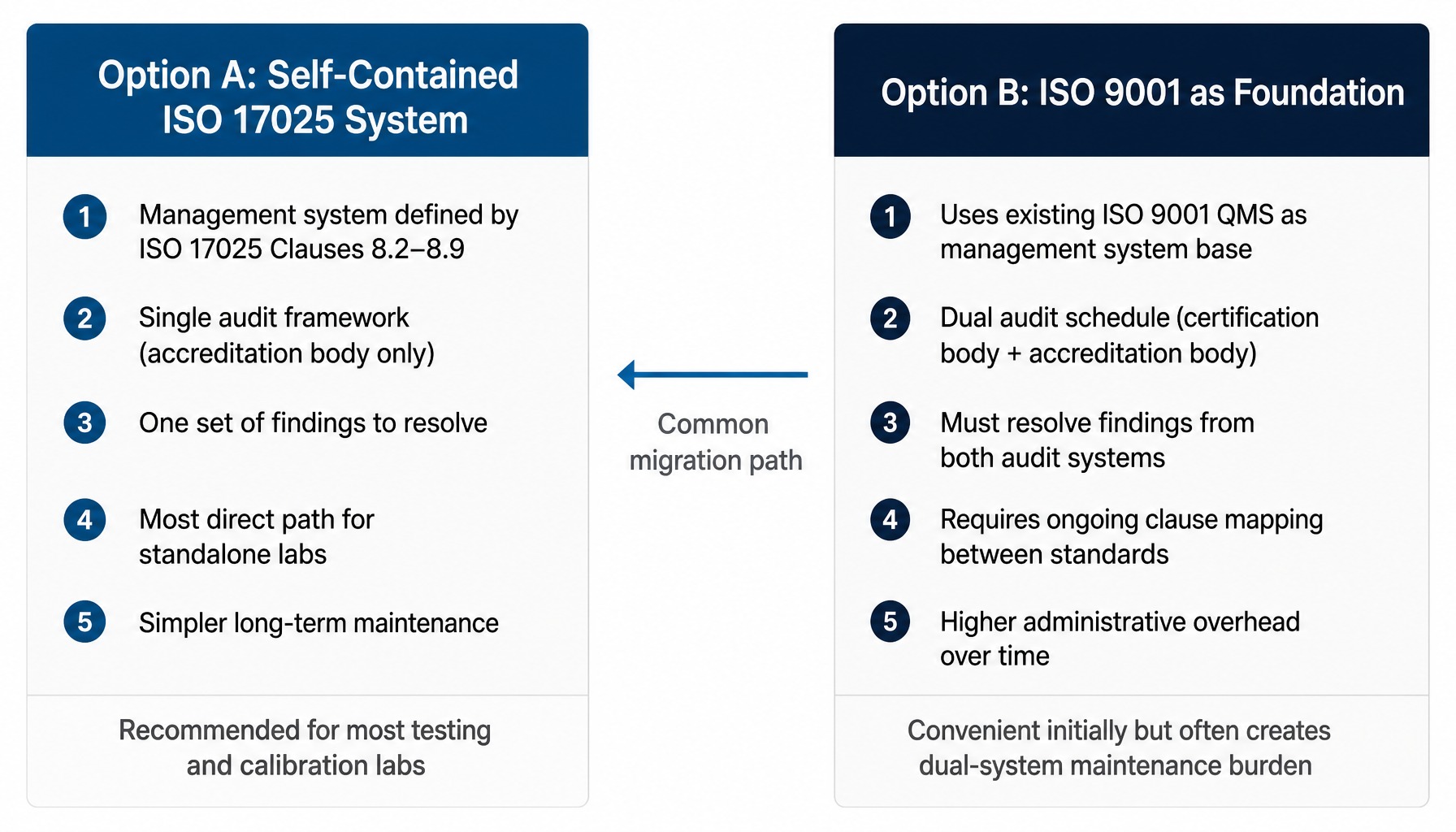
ISO/IEC 17025:2017 offers laboratories a choice in how they structure their management system under Clause 8.1. This decision has significant cost and resource implications that are often overlooked.
Option A requires the laboratory to implement a management system that meets the requirements detailed in Clauses 8.2 through 8.9 of ISO 17025 itself. This creates a single, self-contained system focused entirely on the laboratory's operations. For most standalone testing and calibration labs, this is the most direct and efficient path.
Option B allows a laboratory that has already established and maintains an ISO 9001-compliant management system to use it as the foundation for its QMS. The lab must then demonstrate that its existing system meets the intent of the ISO 17025 management system clauses.
While Option B seems convenient for organizations already holding ISO 9001 certification, it can create a significant dual-system maintenance burden. The lab must manage two separate audit schedules from two different bodies (a certification body for ISO 9001 and an accreditation body for ISO 17025), resolve findings from both, and perform ongoing clause mapping to ensure the systems remain aligned. This is where the paperwork really starts to pile up, often consuming more resources than it saves. For this reason, many labs that initially choose Option B eventually migrate to the simpler, single-audit framework of Option A.
Read more: Frequently Asked Questions | Cal-Cert
When ISO 9001 Is Actually the Right Choice
After detailing the technical rigor of ISO 17025, it's fair to ask: is there ever a time when ISO 9001 is the better, or sufficient, choice for an organization involved in measurement? The answer is yes, but only in specific contexts.
ISO 9001 is the appropriate choice when the organization's primary output is not a measurement result that an external party must trust without their own verification.
Consider a large laboratory services company with multiple divisions. Its calibration division, which issues certificates that clients use for their own compliance, absolutely needs ISO 17025 accreditation. However, its logistics, customer service, or equipment sales divisions would gain little from 17025. For these operational units, ISO 9001 certification is a powerful tool to demonstrate process control and a commitment to quality to their customers.
Similarly, some internal R&D or process control labs use measurements for internal guidance only. If their results are not used for regulatory submissions, product acceptance, or contractual compliance, the significant overhead of ISO 17025 accreditation may not be justified.
The decision criterion is simple: if your deliverable is a measurement result that someone else acts on, ISO 17025 is the expectation. If your deliverable is a product, a service, or an internal process, ISO 9001 is often the more fitting standard.
Why ISO 17025 Accreditation Matters When You Choose a Calibration Provider
The difference between a documented process and demonstrated competence is the foundation of measurement trust. When you select a calibration provider, their ISO/IEC 17025 accreditation is not a marketing badge; it is your assurance that the results on your certificate are technically valid, traceable, and defensible.
As an ISO/IEC 17025-accredited laboratory, Cal-Cert operates within this framework of technical rigor. Our accreditation means an independent body has witnessed our technicians, audited our procedures, and verified our competence for a defined scope of force, dimensional, and other calibration disciplines. Every calibration certificate we issue includes the calculated measurement uncertainty and references the NIST-traceable standards used, providing the objective evidence you need to satisfy auditors and maintain compliance.
This commitment to technical competence extends to both our in-lab and on-site calibration services, ensuring that even large or installed equipment is serviced with the same level of accredited discipline. By partnering with an accredited provider, you aren't just buying a calibration sticker; you are protecting the integrity of your entire measurement program.
Request a quote from Cal-Cert for ISO/IEC 17025 accredited calibration
Conclusion: Answering Different Questions
Ultimately, ISO 9001 and ISO 17025 are not competing standards. They are designed to answer different fundamental questions. The overlap in their management system requirements is real but can be misleading, as the true value and cost of ISO 17025 lies in its demanding technical requirements.
ISO 9001 confirms you have a quality system in place. ISO 17025 confirms your measurement results are competent and reliable.
The technical mandates unique to ISO 17025 measurement uncertainty, decision rules, metrological traceability, and proficiency testing are precisely what make laboratory results defensible rather than merely documented. As clients, regulators, and legal bodies intensify their scrutiny of measurement quality, understanding this distinction is essential. It determines whether the data your lab produces will be accepted, trusted, and acted upon with confidence.
Frequently Asked Questions (FAQ)
Does holding ISO 17025 accreditation eliminate the need for ISO 9001 certification?
For most labs, yes. ISO 17025's Option A management system includes requirements that meet or exceed those in ISO 9001. However, if a specific customer contractually requires a separate ISO 9001 certificate, the lab may need to maintain both. Accreditation bodies do not issue ISO 9001 certificates; that requires an audit from a separate certification body.
What happens if a client requires ISO 17025 accredited results but the lab only holds ISO 9001?
The lab cannot issue a report under an ISO 17025 accreditation mark it does not possess. The client will almost certainly reject the report and require the work to be subcontracted to an accredited laboratory. This is a common failure point in industries like aerospace, medical device manufacturing, and construction materials testing where accredited results are mandated.
Is ISO 17025 accreditation more expensive to maintain than ISO 9001 certification?
Yes, typically. ISO 17025 accreditation costs are higher due to the technical nature of the audits, which include on-site witness assessments by discipline-specific experts. Ongoing costs for proficiency testing participation, reference standard maintenance, and the labor required to manage MU budgets also contribute. The total cost, however, depends heavily on the breadth and complexity of the lab's scope.
Do ISO 17025 labs still need to address risk-based thinking like ISO 9001 requires?
Yes. ISO 17025:2017 Clause 8.5 requires labs to address risks and opportunities, which aligns directly with the risk-based thinking in ISO 9001. However, ISO 17025 applies this concept more pointedly to technical risks, such as threats to impartiality (Clause 4.1) and factors that could invalidate results, making its application more specific than in a general QMS.
How do proficiency testing requirements differ between ISO 17025 and ISO 9001?
The difference is absolute: ISO 9001 has no proficiency testing (PT) requirement. ISO 17025, in Clause 7.7, mandates participation in PT or other interlaboratory comparisons as a primary means of monitoring the validity of results. Failure to perform acceptably in PT rounds is a serious finding that requires formal investigation and corrective action.
How does the upcoming ISO 9001 revision affect labs already accredited to ISO 17025?
The next revision of ISO 9001, anticipated around 2025-2026, will most directly impact labs using Option B for their management system. These labs will need to transition their ISO 9001-based QMS to the new revision while ensuring it still meets ISO 17025 requirements. Labs using Option A are largely insulated, as their management system is defined by ISO 17025 itself.